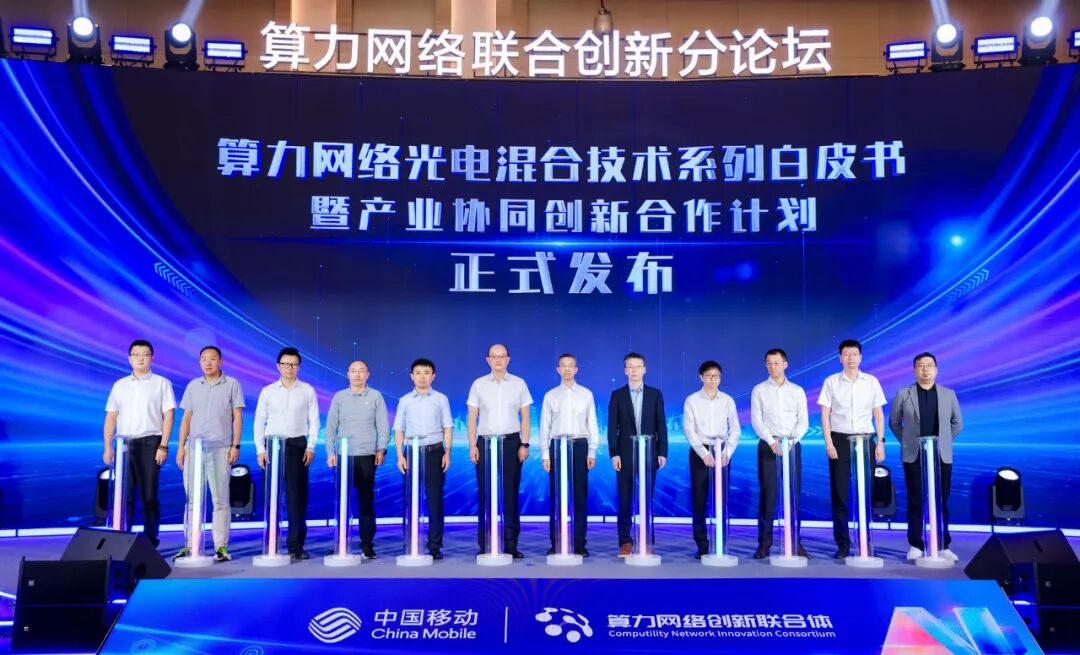
Recently, Yao Jinxin, Vice President of Product Marketing at Lightstandard, attended the Joint Innovation Forum on Computing Power Networks at the 2025 China Mobile Global Partner Conference. At the forum, China Mobile, together with Lightstandard and eight other industry partners, released the "White Paper on optical computing for New Intelligent Computing" and the "White Paper on Optical Interconnection Technology for Large-Scale Intelligent Computing Cluster Scenarios." The white papers systematically elaborate on the architectural evolution, technical roadmap, industrial ecosystem, and standardization direction of optical computing and optical interconnection technologies in ultra-large-scale intelligent computing centers. This marks a substantial step forward in China's AI computing power infrastructure transformation "from electricity to optical," and is of great significance for accelerating the industrialization of optical computing and optical interconnection technologies and building an intelligent optical computing power foundation for computing power networks.
Currently, artificial intelligence is reshaping the service models and operational modes of computing infrastructure at an unprecedented pace. Major countries worldwide are engaged in strategic competition surrounding core elements such as AI computing power, algorithms, and data, with the competition intensifying. Against this backdrop, the integration of computing power with networks, and light with intelligence, is becoming a key direction for next-generation infrastructure.
In addition to the white paper, the forum also released a collaborative innovation cooperation plan between China Mobile and companies such as Lightstandard. The parties will work together along three development paths: First, anchoring the development direction of AI, creating an innovation hub, promoting the construction of computing power interconnection standards, and deploying in cutting-edge fields such as optical computing and optical interconnection; Second, optimizing the collaborative innovation mechanism, improving the achievement transformation system, and promoting resource sharing through jointly undertaking national-level projects and co-building experimental platforms; Third, exploring new scenarios such as computing-electronics collaboration and arithmetic-data fusion to seize the commanding heights of global technological competition.
Recommended News
Recommended News
Recommended News